MOON BORA
From Witness to Changemaker: A Grassroots Woman Leader’s Journey of Courage and Collective Power
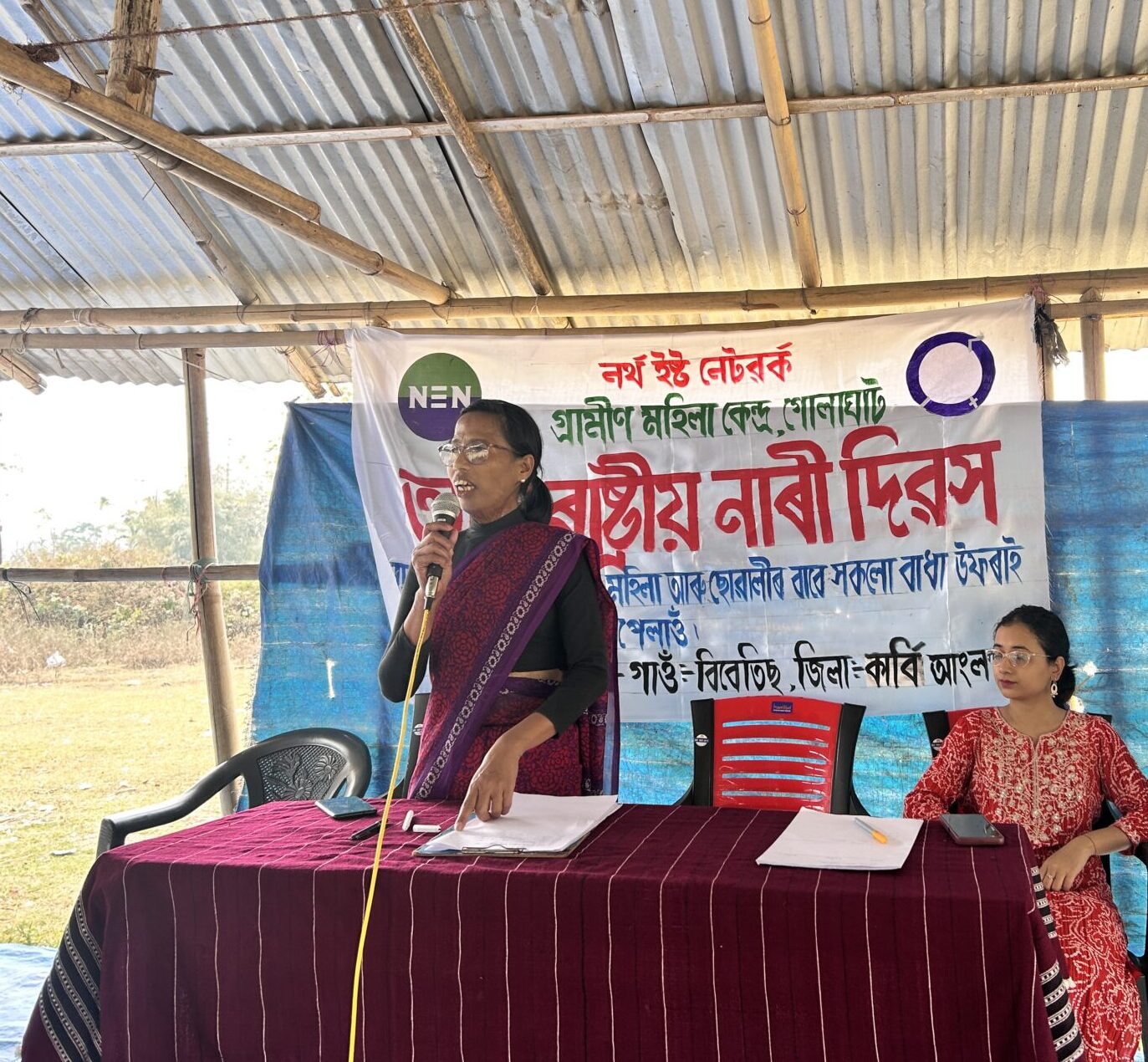
[Trigger Warning: This blog contains mentions of domestic violence and sexual violence, including abuse against a minor. Reader discretion is advised.]
Q. Can you tell us about your journey: how did you first begin working as a grassroots women leader in your community?
My journey began when I was studying in classes nine and ten. At that time, our area was extremely underdeveloped. Even to receive primary education, we had to walk nearly two kilometers to reach school. Our village lacked basic facilities, and the social environment was deeply unhealthy.
What disturbed me the most was what I witnessed inside people’s homes. In almost every household, women were subjected to domestic violence. There was hardly a single family where a woman had not experienced being beaten. Some women worked as daily wage labourers, some worked in tea gardens, and others managed households. They worked tirelessly throughout the day—yet at night many were beaten by their husbands. Alcohol consumption was also very common in the area.
This constant violence affected the entire community, especially children. With quarrels and conflicts happening every night, many children could not study. Some even spent their nights outside their homes to escape the fighting.
As a young girl, witnessing this deeply unsettled me. I felt strongly that things should not continue this way.
So I began with something small but meaningful. I started gathering children in the village. I taught them songs and games, and during summer holidays I helped them with their studies. Slowly, I also began speaking with women in the community. When the women started opening up, they shared the hardships and suffering they were facing. Listening to them made one thing clear: if these problems were ever to change, women would need to come together and organise themselves. That is when we first began thinking about forming a women’s committee. At that time, I never imagined myself as a leader. But the educational situation in our village was so poor that only three children—including me—had reached class ten. The rest had dropped out. The three of us began teaching younger children.
Through these small efforts, the spirit of working for society slowly grew within me.
Later, I learned about the Krishak Mukti Sangram Samiti and became involved in their work. Through its associated women’s organisation, Nari Mukti Sangram Samiti, we began working specifically on women’s issues. During that time, I had the opportunity to serve as the organising secretary of the state committee and later as a district secretary. Around this period, I had heard the word ‘feminism’, but I did not clearly understand its meaning.
That changed after I attended a workshop organised by my organisation where we learned about laws and women’s rights. The experience broadened my perspective.
Soon after, I participated in a leadership development training conducted by North East Network (NEN) for 40–50 women in the community. That training helped me understand how discrimination against women operates and how we can work collectively to protect women’s rights. After the training, I began examining women’s issues much more critically. I became aware of how women were discriminated against even in workplaces simply because we were women.
This awareness also raised questions within my earlier organisation. I began asking why women were excluded from certain decisions and why their safety was not given adequate importance. When I did not receive satisfactory answers, I made the difficult decision to leave the organisation.
For about a year, I stayed at home. Then one day I received an opportunity from NEN—they asked if I would like to work with them. I felt that through an organisation like NEN, I would be able to serve my community more effectively.
I saw it as a meaningful opportunity, and that is how my journey with NEN began. Since then, my work with them has continued.
Q. What were the realities for women in your area when you first started? What kinds of challenges were most visible?
When I first started working in the community, domestic violence was one of the most visible problems women faced. Over time, I also came to understand that sexual violence was taking place, although it was completely hidden. For many years, women did not speak about these experiences. Only much later did some begin to share their stories.
Women also faced severe economic dependence. At that time, Self Help Groups (SHGs) did not exist. Women did not have money of their own and were rarely given money to manage themselves.
Education was another major challenge. There was no free education at the time. Many children could not attend school because their families could not afford books, uniforms, or even basic things like sandals.
These conditions created a cycle where poverty, violence, and lack of opportunity reinforced each other.
Q. As a senior community leader, what kept you motivated to continue this work despite resistance or fatigue?
What has kept me motivated through all these years is a dream—a dream of building a just and equal society.
There are moments when we feel discouraged or exhausted. This is natural. We are human beings, and when the problems around us feel overwhelming, disappointment can set in. But whenever we see even small changes, we regain our courage.
We may not achieve 100 percent transformation immediately. But even if we see 30–40 percent improvement, it gives us hope. When we see confidence emerging on the faces of women—when they begin speaking up, standing up for themselves—that is when we realise our work has meaning.
That belief continues to give me the strength to move forward.
Q. Was there a defining moment when you realised that women in your community needed structured support systems?
There was one incident in our village that deeply shook me.
A sixty-year-old man sexually abused a minor girl who was only 12–13 years old. The girl became pregnant and later gave birth to a child. Initially, no one had the courage to speak up. The silence in the community was painful. But eventually, a group of women came together and decided that this injustice could not be ignored. We went to the police station and filed a case. Even then, the police initially refused to arrest the man because he was influential in the community. We had to organise ourselves and protest at the police station before action was finally taken.
This incident made one thing very clear to me: without organised collective strength, it is extremely difficult to secure justice.
After this, we formed the Nabajiwan Mahila Samiti in our village. Over time, I began noticing important changes in the community as well. Earlier, whenever a conflict occurred, the woman was immediately blamed. She could even be ostracised or socially excluded. But gradually, attitudes began to shift. Today, people are more willing to listen to both sides before making judgments. This change did not happen overnight—it took years of collective effort.
Q. You have worked as a Barefoot Counsellor with the North East Network. What did that training mean to you personally?
My training as a Barefoot Counsellor with North East Network was deeply meaningful for me.
Through the training, we learned how to speak with survivors of domestic violence, how to reassure them, and how to support them in a respectful and sensitive manner. We were trained on how to prepare ourselves before approaching families, and even how our body language should communicate safety and empathy.
Personally, one of the most important things I learned was how to truly show empathy.
Counselling is not only about words. It is also about creating an environment where a woman feels safe. Even our facial expressions and posture matter.
When a woman comes to share her story, I try my best to reduce any barrier or distance between us. I listen carefully and believe her. Confidentiality is extremely important, and we ensure that her trust is never broken. Through counselling, we also share information about women’s rights and the laws that exist to protect them from violence. Women in the community know that we are trained counselors and that we have supported other women for many years. Because of this, they feel more confident coming forward.
Q. Based on your experience, what do you believe still needs to be done to ensure justice for women and to build a truly equitable society?
The world we need is an equal world. The struggle for justice is not something that can be achieved in a single day. It is a continuous process. If we want to transform our communities, we must continue dreaming, organising, and working toward that dream. Change requires persistence.
Q. What message would you like to share with young women leaders this International Women’s Day?
On the occasion of International Women’s Day, my message to young women is simple: Come forward.
Know your rights, and help other women learn about theirs as well. Use opportunities like Women’s Day not just to celebrate, but to talk about rights and spread awareness. It is very important to read and learn about women’s issues and the laws that protect us. If we do not understand these matters deeply, it becomes difficult to raise our voices.
The younger generation has an important role to play. By learning, speaking up, and creating awareness, they can help build a more just and equal society.